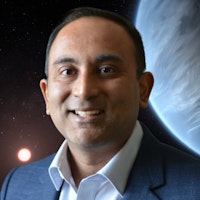
Dr Subhajit Sarkar
- Available for postgraduate supervision
Teams and roles for Subhajit Sarkar
Lecturer
Astronomy Group
Astronomy Instrumentation Group
Cardiff Hub for Astrophysics Research and Technology
Overview
I am a university lecturer and astrophysicist specialising in the study of extrasolar planets, with a particular focus on the atmospheres of temperate sub-Neptunes and gas giants. My research combines observations and theory to investigate the physical and chemical processes that shape these worlds, using atmospheric characterisation to address fundamental questions about planet formation, planetary evolution, and the diversity of exoplanetary systems.
A central theme of my research is the characterisation of temperate exoplanet atmospheres using the James Webb Space Telescope (JWST). Through collaborations with the Institute of Astronomy, University of Cambridge, I use these observations to investigate the origin, composition, and evolution of planets occupying a previously inaccessible region of parameter space. I also lead the Twinkle Cool Gas Giant Survey, a large-scale comparative study of temperate giant exoplanet atmospheres.
Alongside these observational programmes, I contribute to the development of future exoplanet observatories and atmospheric characterisation missions, including ESA's Ariel mission, helping to prepare the next generation of facilities for comparative exoplanet science.
My research also extends to astrobiology, particularly the potential for biospheres in temperate sub-Neptunes and gas giants. I also am interested in how atmospheric observations can be used to constrain the frequency of life-bearing worlds—the fL term in the Drake Equation—and to test competing hypotheses for the origin of life on planetary scales.
Publication
2026
- Binet, M. et al., 2026. A homogeneous survey of JWST-MIRI transmission spectra of 10 exoplanets. The Astrophysical Journal Letters 1008 (2) L42. (10.3847/2041-8213/ae8c2d)
- Holmberg, M. et al., 2026. The mid-infrared transmission spectrum of the temperate sub-Neptune TOI-270 d. The Astrophysical Journal Letters 1005 (2) L53. (10.3847/2041-8213/ae6640)
- Sarkar, S. et al. 2026. Transmission spectrum of the benchmark temperate exo-Neptune TOI-1231 b. The Astrophysical Journal Letters 1005 (2) L52. (10.3847/2041-8213/ae6507)
2025
- Rigby, F. E. et al., 2025. A JWST transmission spectrum of the temperate sub-neptune TOI-732 c. The Astrophysical Journal Letters 995 (2) L70. (10.3847/2041-8213/ae247d)
- Madhusudhan, N. et al., 2025. New constraints on DMS and DMDS in the atmosphere of K2-18 b from JWST MIRI. The Astrophysical Journal Letters 983 (2) L40. (10.3847/2041-8213/adc1c8)
2024
- Bernard, L. et al., 2024. Assembly, integration, and laboratory testing of the EXCITE spectrograph (Erratum). Presented at: SPIE Astronomical Telescopes + Instrumentation Yokohama, Japan 18-20 June 2024. Proceedings Ground-based and Airborne Instrumentation for Astronomy X. Vol. 13096.SPIE. , pp.501. (10.1117/12.3056735)
- Romualdez, L. J. et al., 2024. The Exoplanet Climate Infrared Telescope (EXCITE): gondola pointing and stabilization qualification. Presented at: SPIE Astronomical Telescopes + Instrumentation Yokohama, Japan 16-22 June 2024. Published in: Marshall, H. K. , Spyromilio, J. and Usuda, T. eds. Proceedings of SPIE, Ground-based and Airborne Telescopes X. Vol. 13094., pp.130944Y. (10.1117/12.3018442)
- Kleyheeg, A. et al., 2024. Integration and testing of a cryogenic receiver for the Exoplanet Climate Infrared Telescope (EXCITE). Presented at: SPIE Astronomical Telescopes + Instrumentation, 2024 Yokohama, Japan 16-21 June 2024. Proceedings: Ground-based and Airborne Instrumentation for Astronomy X. SPIE. (10.1117/12.3020522)
- Sarkar, S. et al. 2024. Exoplanet transit spectroscopy with JWST NIRSpec: Diagnostics and homogeneous case study of WASP-39 b. Monthly Notices of the Royal Astronomical Society 531 (2), pp.2731-2756. (10.1093/mnras/stae1230)
- Booth, L. et al. 2024. Cool gaseous exoplanets: surveying the new frontier with twinkle. Monthly Notices of the Royal Astronomical Society 530 (2), pp.2166-2180. (10.1093/mnras/stae461)
2023
- Madhusudhan, N. et al., 2023. Carbon-bearing molecules in a possible Hycean atmosphere. Astrophysical Journal Letters 956 (1) L13. (10.3847/2041-8213/acf577)
- Edwards, B. et al., 2023. Characterizing a world within the hot-neptune desert: Transit observations of LTT 9779 b with the Hubble space telescope/WFC3. Astronomical Journal 166 (4) 158. (10.3847/1538-3881/acea77)
- Seidel, J. V. , Nielsen, L. D. and Sarkar, S. 2023. JWST opens a window on exoplanet skies. Nature (10.1038/d41586-023-00394-6)
- Nikolaou, N. et al., 2023. Lessons learned from the 1st Ariel Machine Learning Challenge: Correcting transiting exoplanet light curves for stellar spots. RAS Techniques and Instruments 2 (1), pp.695-709. (10.1093/rasti/rzad050)
2022
- Mugnai, L. V. et al. 2022. ExoRad2: Generic point source radiometric model. Astrophysics Source Code Library
- Bernard, L. et al., 2022. Design and testing of a low-resolution NIR spectrograph for the EXoplanet Climate Infrared TElescope. Presented at: SPIE Astronomical Telescopes + Instrumentation Montréal, Québec, Canada 17-22 July 2022. Vol. 12184.Society of Photo-optical Instrumentation Engineers. (10.1117/12.2629717)
- Nagler, P. C. et al., 2022. The EXoplanet Climate Infrared TElescope (EXCITE). Presented at: SPIE Astronomical Telescopes + Instrumentation, 2022 Montréal, Québec, Canada 17-22 July 2022. Vol. 12184.Society of Photo-optical Instrumentation Engineers. (10.1117/12.2629373)
- Rehm, T. et al., 2022. The design and development status of the cryogenic receiver for the EXoplanet Climate Infrared TELescope (EXCITE). Presented at: SPIE Astronomical Telescopes + Instrumentation, 2022 Montréal, Québec, Canada 17-22 July 2022. Vol. 12184.Society of Photo-optical Instrumentation Engineers. (10.1117/12.2629588)
- Bowles, N. E. et al., 2022. Ground calibration of the Ariel space telescope: optical ground support equipment design and description. Presented at: SPIE Astronomical Telescopes + Instrumentation, 2022 Montreal, Canada 17-23 July 2022. Proceedings Volume 12180, Space Telescopes and Instrumentation 2022: Optical, Infrared, and Millimeter Wave. Vol. 12180.SPIE. (10.1117/12.2627049)
- Stotesbury, I. et al., 2022. Twinkle: a small satellite spectroscopy mission for the next phase of exoplanet science. Presented at: SPIE Astronomical Telescopes + Instrumentation, 2022 Montréal, Québec, Canada 17-23 July 2022. Proceedings Volume 12180, Space Telescopes and Instrumentation 2022: Optical, Infrared, and Millimeter Wave. SPIE. (10.1117/12.2641373)
- Danielski, C. et al., 2022. The homogeneous characterisation of Ariel host stars. Experimental Astronomy 53 , pp.473-510. (10.1007/s10686-021-09765-1)
- Morello, G. , Danielski, C. and Sarkar, S. 2022. The Ariel 0.6 - 7.8 μm stellar limb-darkening coefficients. Experimental Astronomy 53 , pp.533-545. (10.1007/s10686-021-09740-w)
- Pearson, C. et al., 2022. The Ariel ground segment and instrument operations science data centre. Experimental Astronomy 53 , pp.773-806. (10.1007/s10686-020-09691-8)
- Sarkar, S. 2022. The DRAKE mission: finding the frequency of life in the Cosmos. Monthly Notices of the Royal Astronomical Society (10.1093/mnras/stac175)
2021
- Sarkar, S. and Madhusudhan, N. 2021. JexoSim 2.0: End-to-end JWST simulator for exoplanet spectroscopy - Implementation and case studies. Monthly Notices of the Royal Astronomical Society 508 (1), pp.433-452. (10.1093/mnras/stab2472)
- Sarkar, S. et al. 2021. ExoSim: the exoplanet observation simulator. Experimental Astronomy 51 , pp.287-317. (10.1007/s10686-020-09690-9)
- Mugnai, L. V. et al. 2021. Performance simulations tools for Space Telescopes applied to Ariel space mission. Presented at: European Planetary Science Congress 2021 Virtual 13–24 Sep 2021. EPSC Abstracts. Europlanet Society. , pp.EPSC2021-182. (10.5194/epsc2021-182)
2020
- Mugnai, L. V. et al., 2020. ArielRad: the Ariel radiometric model. Experimental Astronomy 50 , pp.303-328. (10.1007/s10686-020-09676-7)
- Tinetti, G. et al., 2020. Ariel: Atmospheric Remote-sensing Infrared Exoplanet Large-survey - enabling planetary science across light-years. Definition study report.
- Sarkar, S. et al. 2020. ExoSim: the exoplanet observation simulator. [Online].arXiv. Available at: https://arxiv.org/abs/2002.03739.
- Sarkar, S. , Madhusudhan, N. and Papageorgiou, A. 2020. JexoSim: A time domain simulator of exoplanet transit spectroscopy with JWST. Monthly Notices of the Royal Astronomical Society 491 (1), pp.378-397. (10.1093/mnras/stz2958)
2019
- Nagler, P. C. et al., 2019. Observing exoplanets in the near-infrared from a high altitude balloon platform. Journal of Astronomical Instrumentation 8 (3) 1950011. (10.1142/S2251171719500119)
- Edwards, B. et al., 2019. An updated study of potential targets for Ariel. Astronomical Journal 157 (6), pp.242. (10.3847/1538-3881/ab1cb9)
- Edwards, B. et al., 2019. Exoplanet spectroscopy and photometry with the Twinkle space telescope. Experimental Astronomy 47 (1-2), pp.29-63. (10.1007/s10686-018-9611-4)
2018
- Tinetti, G. et al., 2018. A chemical survey of exoplanets with ARIEL. Experimental Astronomy 46 (1), pp.135-209. (10.1007/s10686-018-9598-x)
- Zingales, T. et al., 2018. The ARIEL mission reference sample. Experimental Astronomy 46 (1), pp.67-100. (10.1007/s10686-018-9572-7)
- Pascale, E. et al. 2018. The ARIEL space mission. Presented at: SPIE Astronomical Telescopes + Instrumentation, 2018 Austin, TX, USA 10-15 June 2018. Published in: Lystrup, M. et al., Proceedings Volume 10698, Space Telescopes and Instrumentation 2018: Optical, Infrared, and Millimeter Wave. Vol. 10698.Proceedings of SPIE Bellingham, Washington: Society of Photo-Optical Instrumentation Engineers (SPIE). (10.1117/12.2311838)
- Savini, G. et al., 2018. TWINKLE: a low earth orbit visible and infrared exoplanet spectroscopy observatory. Presented at: SPIE Astronomical Telescopes + Instrumentation 2016 Edinburgh, Scotland 26 June - 1 July 2016. Published in: MacEwen, H. A. et al., Space Telescopes and Instrumentation 2016: Optical, Infrared, and Millimeter Wave. Vol. 9904.SPIE. , pp.99044M. (10.1117/12.2233691)
- Sarkar, S. et al. 2018. Stellar pulsation and granulation as noise sources in exoplanet transit spectroscopy in the ARIEL space mission. Monthly Notices of the Royal Astronomical Society 481 (3), pp.2871-2877. (10.1093/mnras/sty2453)
2017
- Sarkar, S. 2017. Exoplanet transit spectroscopy: development and application of a generic time domain simulator. PhD Thesis , Cardiff University.
2016
- Sarkar, S. , Papageorgiou, A. and Pascale, E. 2016. Exploring the potential of the ExoSim simulator for transit spectroscopy noise estimation. Presented at: SPIE Astronomical Telescopes + Instrumentation Edinburgh, UK 26 June - 1 July 2016. Published in: MacEwen, H. A. et al., Proceedings Volume 9904, Space Telescopes and Instrumentation 2016: Optical, Infrared, and Millimeter Wave. Vol. 99043R.Society of Photo-Optical Instrumentation Engineers (SPIE). (10.1117/12.2234216)
- Tinetti, G. et al., 2016. The science of ARIEL (Atmospheric Remote-sensing Infrared Exoplanet Large-survey). Presented at: SPIE Astronomical Telescopes + Instrumentation Edinburgh, UK 26 June - 1 July 2016. Published in: MacEwen, H. A. et al., Proceedings Volume 9904, Space Telescopes and Instrumentation 2016: Optical, Infrared, and Millimeter Wave. Vol. 9904.The International Society for Optical Engineering. , pp.99041X. (10.1117/12.2232370)
2015
- Pascale, E. et al. 2015. EChOSim: The Exoplanet Characterisation Observatory software simulator. Experimental Astronomy , pp.1-19. (10.1007/s10686-015-9471-0)
2006
- Dalmarco, G. et al., 2006. Evaluation of external cardiac massage performance during hypogravity simulation. Presented at: International Conference of the IEEE Engineering in Medicine and Biology Society New York, US 30 Aug-3 Sep 2006. 2006 International Conference of the IEEE Engineering in Medicine and Biology Society. IEEE. , pp.2904. (10.1109/IEMBS.2006.259444)
2005
- Sarkar, S. et al. 2005. ISIS: The ISS Systematic Initial Survey - a new approach to guiding medical care on orbit. Aviation, Space, and Environmental Medicine 76 (3), pp.74.
2004
- Sarkar, S. 2004. Cardiopulmonary resuscitation in lunar and Martian gravity fields. Presented at: AsMA 75th Annual Scientific Meeting Anchorage, AK, USA 2-6 May 2004. , pp.-.
Articles
- Binet, M. et al., 2026. A homogeneous survey of JWST-MIRI transmission spectra of 10 exoplanets. The Astrophysical Journal Letters 1008 (2) L42. (10.3847/2041-8213/ae8c2d)
- Holmberg, M. et al., 2026. The mid-infrared transmission spectrum of the temperate sub-Neptune TOI-270 d. The Astrophysical Journal Letters 1005 (2) L53. (10.3847/2041-8213/ae6640)
- Sarkar, S. et al. 2026. Transmission spectrum of the benchmark temperate exo-Neptune TOI-1231 b. The Astrophysical Journal Letters 1005 (2) L52. (10.3847/2041-8213/ae6507)
- Rigby, F. E. et al., 2025. A JWST transmission spectrum of the temperate sub-neptune TOI-732 c. The Astrophysical Journal Letters 995 (2) L70. (10.3847/2041-8213/ae247d)
- Madhusudhan, N. et al., 2025. New constraints on DMS and DMDS in the atmosphere of K2-18 b from JWST MIRI. The Astrophysical Journal Letters 983 (2) L40. (10.3847/2041-8213/adc1c8)
- Sarkar, S. et al. 2024. Exoplanet transit spectroscopy with JWST NIRSpec: Diagnostics and homogeneous case study of WASP-39 b. Monthly Notices of the Royal Astronomical Society 531 (2), pp.2731-2756. (10.1093/mnras/stae1230)
- Booth, L. et al. 2024. Cool gaseous exoplanets: surveying the new frontier with twinkle. Monthly Notices of the Royal Astronomical Society 530 (2), pp.2166-2180. (10.1093/mnras/stae461)
- Madhusudhan, N. et al., 2023. Carbon-bearing molecules in a possible Hycean atmosphere. Astrophysical Journal Letters 956 (1) L13. (10.3847/2041-8213/acf577)
- Edwards, B. et al., 2023. Characterizing a world within the hot-neptune desert: Transit observations of LTT 9779 b with the Hubble space telescope/WFC3. Astronomical Journal 166 (4) 158. (10.3847/1538-3881/acea77)
- Seidel, J. V. , Nielsen, L. D. and Sarkar, S. 2023. JWST opens a window on exoplanet skies. Nature (10.1038/d41586-023-00394-6)
- Nikolaou, N. et al., 2023. Lessons learned from the 1st Ariel Machine Learning Challenge: Correcting transiting exoplanet light curves for stellar spots. RAS Techniques and Instruments 2 (1), pp.695-709. (10.1093/rasti/rzad050)
- Danielski, C. et al., 2022. The homogeneous characterisation of Ariel host stars. Experimental Astronomy 53 , pp.473-510. (10.1007/s10686-021-09765-1)
- Morello, G. , Danielski, C. and Sarkar, S. 2022. The Ariel 0.6 - 7.8 μm stellar limb-darkening coefficients. Experimental Astronomy 53 , pp.533-545. (10.1007/s10686-021-09740-w)
- Pearson, C. et al., 2022. The Ariel ground segment and instrument operations science data centre. Experimental Astronomy 53 , pp.773-806. (10.1007/s10686-020-09691-8)
- Sarkar, S. 2022. The DRAKE mission: finding the frequency of life in the Cosmos. Monthly Notices of the Royal Astronomical Society (10.1093/mnras/stac175)
- Sarkar, S. and Madhusudhan, N. 2021. JexoSim 2.0: End-to-end JWST simulator for exoplanet spectroscopy - Implementation and case studies. Monthly Notices of the Royal Astronomical Society 508 (1), pp.433-452. (10.1093/mnras/stab2472)
- Sarkar, S. et al. 2021. ExoSim: the exoplanet observation simulator. Experimental Astronomy 51 , pp.287-317. (10.1007/s10686-020-09690-9)
- Mugnai, L. V. et al., 2020. ArielRad: the Ariel radiometric model. Experimental Astronomy 50 , pp.303-328. (10.1007/s10686-020-09676-7)
- Sarkar, S. , Madhusudhan, N. and Papageorgiou, A. 2020. JexoSim: A time domain simulator of exoplanet transit spectroscopy with JWST. Monthly Notices of the Royal Astronomical Society 491 (1), pp.378-397. (10.1093/mnras/stz2958)
- Nagler, P. C. et al., 2019. Observing exoplanets in the near-infrared from a high altitude balloon platform. Journal of Astronomical Instrumentation 8 (3) 1950011. (10.1142/S2251171719500119)
- Edwards, B. et al., 2019. An updated study of potential targets for Ariel. Astronomical Journal 157 (6), pp.242. (10.3847/1538-3881/ab1cb9)
- Edwards, B. et al., 2019. Exoplanet spectroscopy and photometry with the Twinkle space telescope. Experimental Astronomy 47 (1-2), pp.29-63. (10.1007/s10686-018-9611-4)
- Tinetti, G. et al., 2018. A chemical survey of exoplanets with ARIEL. Experimental Astronomy 46 (1), pp.135-209. (10.1007/s10686-018-9598-x)
- Zingales, T. et al., 2018. The ARIEL mission reference sample. Experimental Astronomy 46 (1), pp.67-100. (10.1007/s10686-018-9572-7)
- Sarkar, S. et al. 2018. Stellar pulsation and granulation as noise sources in exoplanet transit spectroscopy in the ARIEL space mission. Monthly Notices of the Royal Astronomical Society 481 (3), pp.2871-2877. (10.1093/mnras/sty2453)
- Pascale, E. et al. 2015. EChOSim: The Exoplanet Characterisation Observatory software simulator. Experimental Astronomy , pp.1-19. (10.1007/s10686-015-9471-0)
- Sarkar, S. et al. 2005. ISIS: The ISS Systematic Initial Survey - a new approach to guiding medical care on orbit. Aviation, Space, and Environmental Medicine 76 (3), pp.74.
Conferences
- Bernard, L. et al., 2024. Assembly, integration, and laboratory testing of the EXCITE spectrograph (Erratum). Presented at: SPIE Astronomical Telescopes + Instrumentation Yokohama, Japan 18-20 June 2024. Proceedings Ground-based and Airborne Instrumentation for Astronomy X. Vol. 13096.SPIE. , pp.501. (10.1117/12.3056735)
- Romualdez, L. J. et al., 2024. The Exoplanet Climate Infrared Telescope (EXCITE): gondola pointing and stabilization qualification. Presented at: SPIE Astronomical Telescopes + Instrumentation Yokohama, Japan 16-22 June 2024. Published in: Marshall, H. K. , Spyromilio, J. and Usuda, T. eds. Proceedings of SPIE, Ground-based and Airborne Telescopes X. Vol. 13094., pp.130944Y. (10.1117/12.3018442)
- Kleyheeg, A. et al., 2024. Integration and testing of a cryogenic receiver for the Exoplanet Climate Infrared Telescope (EXCITE). Presented at: SPIE Astronomical Telescopes + Instrumentation, 2024 Yokohama, Japan 16-21 June 2024. Proceedings: Ground-based and Airborne Instrumentation for Astronomy X. SPIE. (10.1117/12.3020522)
- Bernard, L. et al., 2022. Design and testing of a low-resolution NIR spectrograph for the EXoplanet Climate Infrared TElescope. Presented at: SPIE Astronomical Telescopes + Instrumentation Montréal, Québec, Canada 17-22 July 2022. Vol. 12184.Society of Photo-optical Instrumentation Engineers. (10.1117/12.2629717)
- Nagler, P. C. et al., 2022. The EXoplanet Climate Infrared TElescope (EXCITE). Presented at: SPIE Astronomical Telescopes + Instrumentation, 2022 Montréal, Québec, Canada 17-22 July 2022. Vol. 12184.Society of Photo-optical Instrumentation Engineers. (10.1117/12.2629373)
- Rehm, T. et al., 2022. The design and development status of the cryogenic receiver for the EXoplanet Climate Infrared TELescope (EXCITE). Presented at: SPIE Astronomical Telescopes + Instrumentation, 2022 Montréal, Québec, Canada 17-22 July 2022. Vol. 12184.Society of Photo-optical Instrumentation Engineers. (10.1117/12.2629588)
- Bowles, N. E. et al., 2022. Ground calibration of the Ariel space telescope: optical ground support equipment design and description. Presented at: SPIE Astronomical Telescopes + Instrumentation, 2022 Montreal, Canada 17-23 July 2022. Proceedings Volume 12180, Space Telescopes and Instrumentation 2022: Optical, Infrared, and Millimeter Wave. Vol. 12180.SPIE. (10.1117/12.2627049)
- Stotesbury, I. et al., 2022. Twinkle: a small satellite spectroscopy mission for the next phase of exoplanet science. Presented at: SPIE Astronomical Telescopes + Instrumentation, 2022 Montréal, Québec, Canada 17-23 July 2022. Proceedings Volume 12180, Space Telescopes and Instrumentation 2022: Optical, Infrared, and Millimeter Wave. SPIE. (10.1117/12.2641373)
- Mugnai, L. V. et al. 2021. Performance simulations tools for Space Telescopes applied to Ariel space mission. Presented at: European Planetary Science Congress 2021 Virtual 13–24 Sep 2021. EPSC Abstracts. Europlanet Society. , pp.EPSC2021-182. (10.5194/epsc2021-182)
- Pascale, E. et al. 2018. The ARIEL space mission. Presented at: SPIE Astronomical Telescopes + Instrumentation, 2018 Austin, TX, USA 10-15 June 2018. Published in: Lystrup, M. et al., Proceedings Volume 10698, Space Telescopes and Instrumentation 2018: Optical, Infrared, and Millimeter Wave. Vol. 10698.Proceedings of SPIE Bellingham, Washington: Society of Photo-Optical Instrumentation Engineers (SPIE). (10.1117/12.2311838)
- Savini, G. et al., 2018. TWINKLE: a low earth orbit visible and infrared exoplanet spectroscopy observatory. Presented at: SPIE Astronomical Telescopes + Instrumentation 2016 Edinburgh, Scotland 26 June - 1 July 2016. Published in: MacEwen, H. A. et al., Space Telescopes and Instrumentation 2016: Optical, Infrared, and Millimeter Wave. Vol. 9904.SPIE. , pp.99044M. (10.1117/12.2233691)
- Sarkar, S. , Papageorgiou, A. and Pascale, E. 2016. Exploring the potential of the ExoSim simulator for transit spectroscopy noise estimation. Presented at: SPIE Astronomical Telescopes + Instrumentation Edinburgh, UK 26 June - 1 July 2016. Published in: MacEwen, H. A. et al., Proceedings Volume 9904, Space Telescopes and Instrumentation 2016: Optical, Infrared, and Millimeter Wave. Vol. 99043R.Society of Photo-Optical Instrumentation Engineers (SPIE). (10.1117/12.2234216)
- Tinetti, G. et al., 2016. The science of ARIEL (Atmospheric Remote-sensing Infrared Exoplanet Large-survey). Presented at: SPIE Astronomical Telescopes + Instrumentation Edinburgh, UK 26 June - 1 July 2016. Published in: MacEwen, H. A. et al., Proceedings Volume 9904, Space Telescopes and Instrumentation 2016: Optical, Infrared, and Millimeter Wave. Vol. 9904.The International Society for Optical Engineering. , pp.99041X. (10.1117/12.2232370)
- Dalmarco, G. et al., 2006. Evaluation of external cardiac massage performance during hypogravity simulation. Presented at: International Conference of the IEEE Engineering in Medicine and Biology Society New York, US 30 Aug-3 Sep 2006. 2006 International Conference of the IEEE Engineering in Medicine and Biology Society. IEEE. , pp.2904. (10.1109/IEMBS.2006.259444)
- Sarkar, S. 2004. Cardiopulmonary resuscitation in lunar and Martian gravity fields. Presented at: AsMA 75th Annual Scientific Meeting Anchorage, AK, USA 2-6 May 2004. , pp.-.
Monographs
- Tinetti, G. et al., 2020. Ariel: Atmospheric Remote-sensing Infrared Exoplanet Large-survey - enabling planetary science across light-years. Definition study report.
Other
- Mugnai, L. V. et al. 2022. ExoRad2: Generic point source radiometric model. Astrophysics Source Code Library
Thesis
- Sarkar, S. 2017. Exoplanet transit spectroscopy: development and application of a generic time domain simulator. PhD Thesis , Cardiff University.
Websites
- Sarkar, S. et al. 2020. ExoSim: the exoplanet observation simulator. [Online].arXiv. Available at: https://arxiv.org/abs/2002.03739.
Research
Research Vision
My research aims to understand how planetary atmospheres can be used to answer two of the most fundamental questions in modern astronomy: How common is life in the Universe? and How do planetary systems form and evolve? By combining observations from the James Webb Space Telescope (JWST) with the development of future space missions, atmospheric modelling, and statistical inference, I seek to establish exoplanet atmospheres as a powerful tool for comparative planetology and astrobiology.
1. Searching for Life Beyond the Solar System
Atmospheric characterisation of temperate worlds
A major focus of my research is the atmospheric characterisation of temperate and habitable-zone exoplanets, particularly sub-Neptunes and proposed Hycean worlds. Through collaborations with the Institute of Astronomy, University of Cambridge, I am a Co-Investigator on two major JWST observing programmes that use NIRISS, NIRSpec, and MIRI spectroscopy to study the atmospheres of temperate sub-Neptunes, including K2-18 b and a sample of potential Hycean candidates. These observations provide an unprecedented opportunity to investigate the chemistry, climate, and potential habitability of planets occupying a previously inaccessible region of parameter space.
Biosignatures and atmospheric modelling
Observations alone cannot establish the presence of life without robust theoretical frameworks. My research therefore develops atmospheric and statistical models to interpret biosignatures and quantify their significance. I am particularly interested in determining how atmospheric observations can constrain the frequency of life-bearing worlds—the fL term in the Drake Equation. This includes developing statistical frameworks, such as those presented in my MNRAS paper on the DRAKE mission concept, together with atmospheric models that improve our understanding of biosignature production, preservation, and detectability.
2. Explaining the Diversity of Planetary Atmospheres
Comparative atmospheric studies with JWST
I use JWST observations to investigate the physical and chemical processes that shape exoplanet atmospheres across a broad range of planetary environments. Alongside observational programmes targeting temperate sub-Neptunes, I develop analysis tools for extracting atmospheric spectra from JWST observations. This includes the development of JexoPipe, a dedicated reduction and analysis pipeline, and JexoSim, a time-domain simulator for generating realistic observations and testing retrieval methodologies.
The Twinkle Cool Gas Giant Survey
I lead the Twinkle Cool Gas Giant Survey, a large-scale comparative survey of temperate giant exoplanets. The survey is designed to explore a largely unstudied population of planets that bridges the gap between hot Jupiters and the cold giant planets of our own Solar System. By measuring atmospheric composition, chemistry, and global trends across a statistically significant sample, the survey will establish the foundations of comparative studies of temperate giant exoplanets.
Hubble Space Telescope observations
My research has also included Hubble Space Telescope spectroscopy to investigate atmospheric variability and planetary evolution. Previous projects include studies of the hot Neptune LTT-9779 b and temporal changes in the atmosphere of the benchmark hot Jupiter HD 209458 b.
3. Developing the Next Generation of Exoplanet Observatories
In parallel with my observational research, I contribute to the design and scientific development of future exoplanet facilities. I have played a leading role in performance simulations, instrument modelling, and software development for ESA's Ariel mission, including the development of the original Ariel data reduction pipeline (ADaRP) and successive versions of the ExoSim simulator. I continue to contribute through leadership roles in Ariel's science and ground-segment working groups, including convening the Complementary Science Working Group.
Long-term vision
Over the next decade, I aim to combine JWST, Twinkle, Ariel, and future observatories to build a coherent understanding of planetary atmospheres across a wide range of environments. By linking atmospheric physics, comparative planetology, and astrobiology, my goal is to determine how planetary atmospheres evolve, how common habitable environments may be, and ultimately how observations can constrain the prevalence of life in the Universe.
Software developed
- ExoSim, SpotSim, ExoSim_N, JexoSim (JWST simulator), TwinkleSim, ADaRP, JexoPipe
Teaching
Current undergraduate teaching
- PX4245 / PXT145 Exoplanets and the Search for Life: Module Organiser
- PX2140 Stars and Planets: Deputy Module Organiser
- Additionally I am DMO for Electromagnetism and Waves, and Astrophysics in Action
Previous undergraduate teaching
- PX1127 Planet Earth: Module Organiser
- PX2140 Stars and Planets: guest lecturer
- PX1127 Planet Earth: Deputy Module Organiser
- PX2134 Structured Programming: Lab supervisor
- PX1125 Mathematical Practice for Physical Sciences: Marker
- PX1222 Mathematical Methods for Physicists 2: Marker
Other
- I supervise PhD, MPhys, MSc and BSc research projects (see supervision page)
Biography
Education
- PhD, Astrophysics, Cardiff University
- MSc (Distinction), Space Science, University College London
- Diploma in Physics (Distinction), Open University
- MA, Natural Sciences, Cambridge University
- MB, BChir, Medicine, Cambridge University
- Grad. Cert. Applied Sciences, Space Studies, University of South Australia
- Space Studies Program, International Space University
Professional memberships
- Fellow of the Royal Astronomical Society
- Fellow of the Higher Education Academy
Academic positions
- 2026-Present: Senior Lecturer, Cardiff University
- 2022-2026: Lecturer in Exoplanet Characterisation, School of Physics and Astronomy, Cardiff University
- 2017-2021: Post-doctoral Research Associate, Cardiff University
- 2013-2017: Post-graduate Research Student, Cardiff University
- 2003-2005: Visiting Researcher, Space Medicine & Health Care Systems Office, NASA Johnson Space Center, Houston.
- 2003-2005: Honorary Lecturer in Space Life Sciences, Dept. of Space & Climate Physics, University College London
Outreach and Media
- BBC Radio Wales Science Cafe interview about the ARIEL space mission (April 2018).
- Pythagorean Astronomy podcast interview about TESS, ARIEL and other exoplanet missions (April 2018).
- Exoplanet talks for Cardiff AS Level Summer Programmes 2018/19.
- Stargazing talk and telescope observing with Scouts (Spring 2019).
- Online astronomy talk with Scouts (Winter 2020).
- 'All About Space' magazine interview about Ariel mission ('Rise of the Exoplanet Hunter') (Jan 2021).
- Twinkle mission YouTube video ('The Founding Members') (Aug 2021).
- Pythagorean Astronomy podcast interview about JWST observing programme (Dec 2021).
- Cardiff School of Physics & Astronomy YouTube video about JWST (Dec 2021).
- BBC News Wales interview about exoplanets and JWST (July 2022).
- Nature News and Views article on JWST (Feb 2023).
- NASA/ESA Press release on JWST K2-18 b observation (Sep 2023)
- BBC News interview ('Alien life in the Universe') (Sep 2023)
- Le Parisien interview (Sep 2023)
- Hindustan Times interview (Sep 2023)
- News9Live (India) interview (Sep 2023)
- Kosmo magazine (Italy) interview (Oct 2023)
- IoP Festival of Physics, keynote speaker ('Exoplanets and the Search for Life') (Nov 2023)
- Astronomy on Tap (Cardiff) speaker (Nov 2023)
- Cardiff/Cambridge Press release on K2-18 b (April 2025)
- BBC News article on K2-18 b (April 2025)
- BBC Wales Radio interview (April 2025)
- RTE radio interview (April 2025)
- Sky News TV interview ("The News Hour with Mark Austin") (April 2025)
- The Standard podcast interview (April 2025)
- BBC Future interview "Exploring the peculiar smells of outer space" (May 2025)
- Scholastic "Science World" interview (June 2025)
- Sky News TV interview ("The World with Yalda Hakim") (Feb 2026)
- Cardiff University social media video about alien life (March 2026)
Committees and reviewing
- I am the post-graduate admissions tutor for the Astronomy Group.
- I currently serve on the following school committees: a) Equality, diversity and inclusion (EDI), b) Environment and sustainability.
- I am on the CHART-GEI Schools Engagement Project management team and the Astronomy Instrumentation Group management team.
- I have previously served on the Ethics committee and MSc approval panel.
- JWST TAC exoplanet panel member for cycle 3 and cycle 4
- Grant reviewer for French National Research Agency and UKRI.
- I have refereed publications for journals including PASP, Nature and International Jourmal of Astrobiology.
Supervisions
Current supervision
- I am currently primary PhD supervisor for Megan Mealing.
- My previous PhD student, Luke Booth, graduated in 2026.
- I am currently on the supervisory team as mentor for a number of PhD students.
- I currently supervise the undergraduate project "Exoplanet transmission spectroscopy"
Current supervision

Past projects
- Previous undergraduate and MSc projects include: "Missions to the Planets", "Habitable exomoons", "Transmission spectroscopy of water", "Designing a telescope to observe Earth-like planet atmosphere", "Simulations for the Twinkle space mission", "Impact of star spots on exoplanet transmission spectroscopy"
News articles


Contact Details
+44 29225 14790
Queen's Buildings - North Building, Room N/2.11, 5 The Parade, Newport Road, Cardiff, CF24 3AA
Research themes
Specialisms
- Exoplanets
- Astrobiology


